Is Perimenopause Running the Show (and Not Letting You Read the Script)?
Let’s change that—starting today.
Perimenopause can feel like a full-time job no one trained you for. The mood swings. The fatigue. The 3AM anxiety spirals. Sound familiar?
You don’t have to do this alone—and you shouldn’t
have to piece it together from late-night Google searches. That’s why I created these free guides to help you cut through the chaos and start feeling like you again.
Grab one now and get real-life tools to support your hormones, energy, mood, and more.
What Even is Perimenopause?
Think of it like the winding (and sometimes bumpy) road leading up to menopause. It usually kicks off in your 40s—but for some women, it can start even earlier.
Hormone shifts during this time can cause symptoms like:
✅Hot flashes that hit out of nowhere
✅Mood swings that rival your teen years
✅Night sweats, brain fog, and libido plot twists
✅Irregular periods that love to keep you guessing
Sound familiar?
It can feel like your body’s rewriting the script without telling you—but here’s the thing:
You’re not broken. You’re transitioning. And it’s completely normal.
The key is having the right tools, support, and knowledge to navigate it with more clarity (and a lot less confusion).
Hi, I'm Kim
Holistic Nutritionist. Certified Menopause Coaching Specialist. Midlife truth-teller.
I’ve been where you are—confused, exhausted, and wondering if I was the only one Googling “why do I feel like a hormonal alien?” at 3AM.
Now, I help women in midlife ditch the guesswork and get real support for their hormones, health, and emotional well-being. My approach blends science-backed tools, mindset shifts, and plenty of permission to not have it all together!
This isn’t just about surviving perimenopause.
It’s about reclaiming your energy, your mood, your body—and your joy.
My Approach: Real Support, Real Women, Real Results
Let’s be real—midlife health advice often feels like it was written for 25-year-olds with zero hormone chaos and unlimited time. That’s not you. And it’s definitely not me.
Here’s what I believe:
✅You don’t need to “push through” or “just deal with it.”
✅Your symptoms aren’t in your head—they’re in your hormones.
✅Real change happens when we stop judging ourselves and start supporting ourselves (with food, movement, rest, and compassion).
As a Holistic Nutritionist and Menopause Coaching Specialist, I focus on science-backed strategies
blended with grace, humor, and zero shame. Whether you’re dealing with mood swings, fatigue, or a libido that ghosted you—there’s a way forward.
My work isn’t about perfection—it’s about giving your body what it needs and your mind the space to catch up.
From the Blog: Real Talk for Real Hormones
No fluff. No fear-mongering. Just science-backed advice, cheeky encouragement, and the kind of midlife support you actually want to read. Whether you're riding the emotional rollercoaster or wondering if brain fog is your new personality—I've got you.
Build Your Muscle-Supporting Plate: How Women Over 40 Should Eat for Strength and Energy
✨ The Go-To Hormone-Loving Meal Guide: Simple, Supportive Meals for Perimenopause ✨
When food decisions feel exhausting, this helps.
👉 Download the free guide!
✨ Perimenopause Power Moves: 5 Simple Nutrition Shifts to Help You Feel Like Yourself Again! ✨
Grab your free guide today!
👉 Download Now!
Build Your Muscle-Supporting Plate: How Women Over 40 Should Eat for Strength and Energy
“Essential amino acids. These come directly from your diet. Although they’re called essential, even the aminos in this category are not equally essential. That’s because it’s harder to attain adequate amounts of certain AAs—such as leucine, methionine, and lysine—without consuming animal foods.”
~ Gabrielle Lyon, Forever Strong™: A New, Science-Based Strategy for Aging Well
If you read my previous article, Muscle Is Medicine: Why Women Over 40 Need to Protect Their Skeletal Muscle, you already know something important:
Skeletal muscle isn’t just about looking toned.
It’s one of the most powerful drivers of metabolism, energy, and long-term health across the entire lifespan.
But for many women, the importance of muscle becomes especially noticeable during perimenopause, when hormonal changes begin affecting metabolism, strength, and body composition.
Suddenly the habits that once worked don’t seem to work the same way.
Energy dips.
Strength becomes harder to maintain.
Weight feels more stubborn.
These changes often bring attention to something that has been quietly happening for years:
We naturally lose muscle as we age.
Supporting skeletal muscle isn’t just a midlife strategy — it’s a lifelong investment in health. And the older we get, the more important protein intake and resistance training become for maintaining strength, metabolism, and resilience.
But once women understand that muscle matters, the next question is usually:
“Okay… so what should I actually eat?”
The answer begins with something simple:
Build your plate around protein first.
Why Protein Matters So Much After 40
Protein is the primary nutrient required to maintain skeletal muscle.
It provides amino acids — the building blocks your body uses to repair tissues, support metabolism, and maintain muscle mass.
As we age, our bodies become less efficient at building muscle, which means protein intake becomes even more important.
Many experts suggest women benefit from aiming for roughly:
0.7–1 gram of protein per pound of body weight per day.
For a 150-pound woman, that’s about:
105–150 grams of protein per day.
A helpful strategy is aiming for approximately:
30–40 grams of protein per meal.
This supports muscle protein synthesis, helps stabilize blood sugar, and keeps energy levels steady throughout the day.
Unfortunately, many women are eating far less than this.
A typical day might look like:
Breakfast: toast or oatmeal
Lunch: a salad
Dinner: pasta or rice dish
That may only provide 40–60 grams of protein per day, which isn’t enough to support skeletal muscle as we age.
If you'd like to learn more about why protein becomes so important in midlife, you may enjoy my article:
Flex Appeal: Why Women Over 40 Need More Protein Than Ever
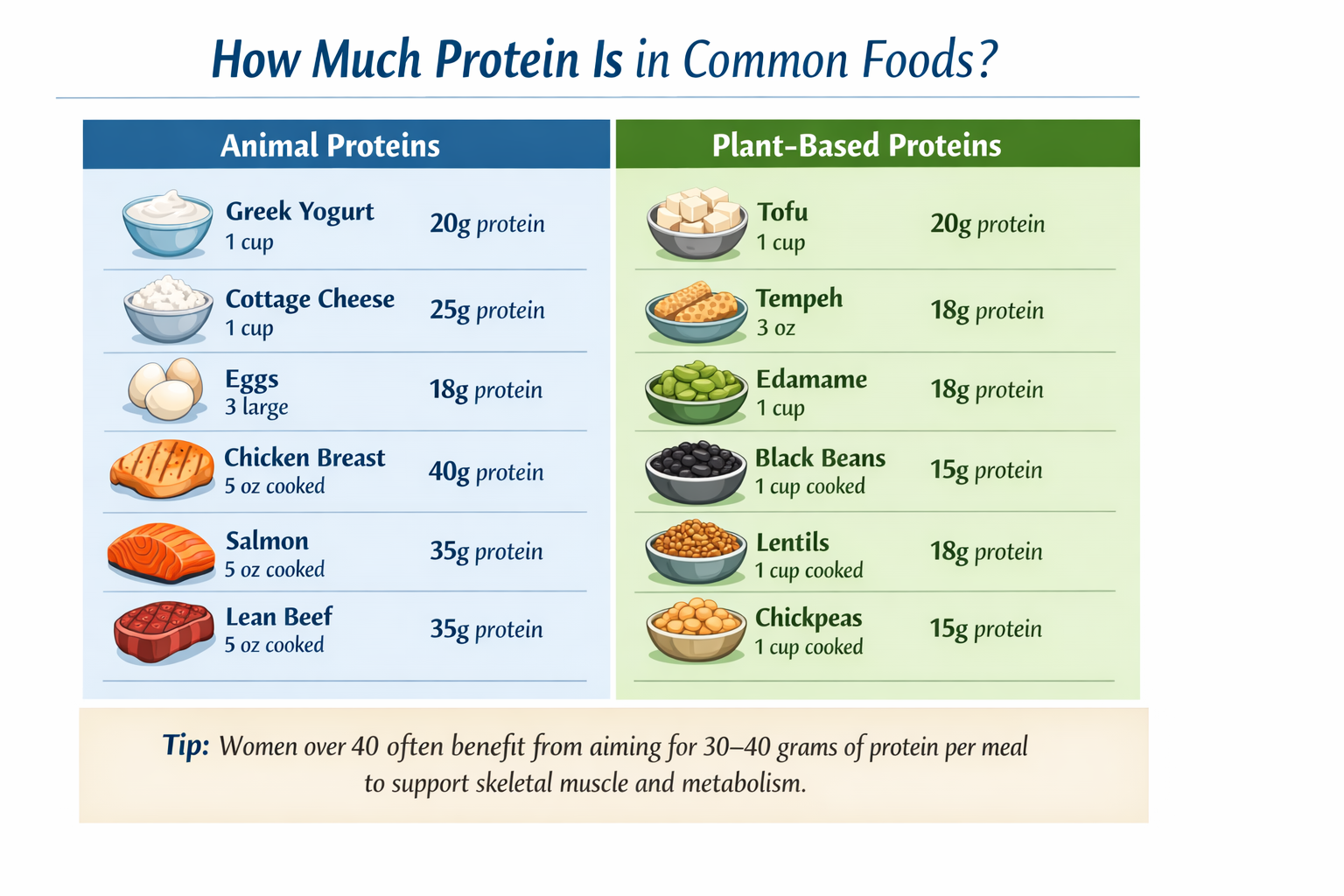
What 30–40 Grams of Protein Actually Looks Like
Understanding protein amounts makes it much easier to build balanced meals.
Here are some common foods and their approximate protein content.
Greek yogurt
1 cup = ~20g protein
Cottage cheese
1 cup = ~25g protein
Eggs
3 large eggs = ~18g protein
Chicken breast
5 oz cooked = ~40g protein
Salmon
5 oz cooked = ~35g protein
Lean beef
5 oz cooked = ~35g protein
Tofu
1 cup = ~20g protein
Tempeh
3 oz = ~18g protein
Edamame
1 cup = ~18g protein
When meals start with a solid protein source, reaching your daily protein target becomes much easier.
Why It Helps to Front-Load Protein Earlier in the Day
One of the most common patterns I see is women eating very little protein early in the day.
Breakfast might be toast, cereal, or oatmeal.
Lunch might be a light salad.
Then by dinner we try to fit in most of the day's protein.
The problem is that it becomes very difficult to reach adequate protein intake this way.
Instead, it helps to spread protein across the day and start strong in the morning.
Front-loading protein earlier in the day can help:
• support muscle protein synthesis
• stabilize blood sugar
• prevent afternoon energy crashes
• reduce cravings later in the day
• make it easier to reach your protein target
For example:
Breakfast example (30–35g protein)
1 cup Greek yogurt (~20g)
2 tbsp chia seeds (~4g)
¼ cup pumpkin seeds (~8g)
Lunch example (35–40g protein)
4–5 oz grilled chicken breast
Large salad with vegetables and olive oil
Starting the day with protein often makes the entire day of eating feel easier and more balanced.
If you'd like help increasing protein intake step-by-step, my Protein Power Challenge: 10 Days to Boost Your Energy, Strength & Hormonal Health walks through simple ways to build meals that support muscle and metabolism.
Building a Muscle-Supporting Plate
Once you start with protein, the rest of the plate becomes much easier to build.
A muscle-supporting plate includes:
1️⃣ Protein first
2️⃣ Fiber-rich plants and smart carbohydrates
3️⃣ Healthy fats (often already in the protein)
This combination supports muscle, metabolism, energy, and hormone health.
Fiber-Rich Plants and Smart Carbohydrates
Many of the foods that provide carbohydrates are also rich in fiber and nutrients, especially plant foods.
These fiber-rich foods help:
• stabilize blood sugar
• support digestion and gut health
• provide sustained energy
• nourish beneficial gut bacteria
Examples include:
• vegetables
• lentils
• beans
• quinoa
• sweet potatoes
• berries
• whole grains
Because these foods contain fiber and nutrients, they help create a more balanced and satisfying meal, especially when paired with protein.
Healthy Fats (Often Built Into Protein Foods)
Healthy fats support hormone health, brain function, and satiety.
The good news is that many protein foods already contain healthy fats, meaning they come built into the meal.
For example:
• salmon
• eggs
• beef
• full-fat Greek yogurt
• cottage cheese
These foods naturally provide both protein and fat, helping meals feel satisfying.
You can also add healthy fats through foods such as:
• avocado
• olive oil
• nuts
• seeds
But often, when you start with a solid protein source, you're already getting some healthy fats naturally.
A Note for Vegetarians
“The proteins in beans or quinoa, for example, contain significantly different AA profiles from those of beef or chicken. If you choose lower-quality protein sources, you will need to consume greater quantities or find supplemental options. By and large, animal proteins, which contain the highest quantities of essential AAs, will serve you best in supplying the aminos critical for sustaining the body’s protein-reliant systems—including muscle. It’s not impossible to get these through eating an ovo-lacto vegetarian diet rich in dairy and eggs. It’s not even impossible to get these in a vegan diet, although your options will be limited, and you might need supplements to prevent a deficiency.”
~ Gabrielle Lyon, Forever Strong™: A New, Science-Based Strategy for Aging Well
Vegetarian diets can absolutely support skeletal muscle — but they do require a bit more planning.
Plant proteins are generally less concentrated sources of protein, meaning larger portions may be needed.
For example:
5 oz chicken breast
≈ 40g protein
To get close to that amount from rice and beans, you might need:
2 cups black beans (~30g protein)
1 cup brown rice (~5g protein)
That’s roughly 35 grams of protein and a much larger portion of food.
Not impossible — but definitely more of a commitment than a single piece of chicken.
Helpful plant-based protein sources include:
• lentils
• beans
• tofu
• tempeh
• edamame
• eggs
• Greek yogurt
• cottage cheese
• plant-based protein powders
The key is simply being intentional about reaching your protein target.
What a Muscle-Supporting Day of Eating Might Look Like
Breakfast
Greek yogurt with berries and chia seeds
Lunch
Salmon salad with quinoa and vegetables
Dinner
Chicken stir-fry with vegetables and brown rice
Snack
Protein smoothie or cottage cheese with fruit
Meals like this help support skeletal muscle, stable energy, and metabolic health.
Need Help Building Balanced Meals?
If you're unsure how to put these pieces together into everyday meals, you're not alone.
That’s exactly why I created my free guide:
Create Your Go-To Hormone-Loving Meals
Inside, you'll learn how to build simple, balanced meals that support protein intake, energy, and hormone health during perimenopause.
The Bottom Line
Supporting skeletal muscle doesn’t require a perfect diet.
It simply requires consistent meals built around protein.
When women shift from a carbohydrate-centered plate to a protein-first plate, everything begins to change.
Energy improves.
Strength improves.
Metabolism becomes more resilient.
Because the way we eat in midlife plays a powerful role in maintaining strength, metabolism, and long-term health.
And it all starts with something surprisingly simple:
building a plate around protein.
Hormonally yours,
Kimberlee Erin
Just a heads-up: I’m a Certified Menopause Coaching Specialist and Holistic Nutritionist, and while I love sharing what’s worked for me and my clients, this blog is for informational purposes only. It’s not a substitute for medical advice. Always check in with your healthcare provider before starting new supplements, hormones, or treatments—especially since every woman’s perimenopause journey is different. You deserve personalized care that truly fits you.

Meeting Kim was a turning point in my perimenopause journey. I was overwhelmed by the constant fatigue and emotional ups and downs. Kim’s holistic approach helped me understand what my body was going through. Her personalized nutrition plans and stress management techniques have been a lifesaver. I now feel more balanced and in control of my health. Kim's support has been nothing short of amazing.
- LIZ
FREE DOWNLOAD